Phang Nga Bay Tours From Krabi: Caves, Karsts and Canoes
Phang Nga Bay holds more than forty limestone islands between Krabi and Phuket, and a good number of them are hollow. The tours worth booking are the ones that get inside the rock rather than past it. Here is how the formats differ and which one fits your day.
Compare the direct-sea speedboat with longtail and cave-kayak alternatives before choosing your Phang Nga experience. Explore James Bond & Hong Speedboat.
Reach the bay at eight in the morning and the karsts are still grey. An hour later they have gone green at the waterline and white where the sun catches the upper cliffs, and by the time the first canoe slides into a tunnel the water underneath has turned the colour of bottle glass. The islands look like they were dropped there. Geologically it is the opposite: what stands is what was left after everything softer washed away.
Booking choice: For James Bond, Hong Islands and Koh Yao Noi without the conventional road approach, consider the direct-sea speedboat. Check dates for James Bond & Hong Speedboat.
What Is Phang Nga Bay and Why Does It Look Like That?
Phang Nga Bay is the shallow sea between Krabi and Phuket, filled with more than forty limestone karst islands. Many are hollow, the remains of ancient cave systems whose roofs collapsed and opened them to the sky. The bay's signature experience is paddling into those chambers, not sailing past them.
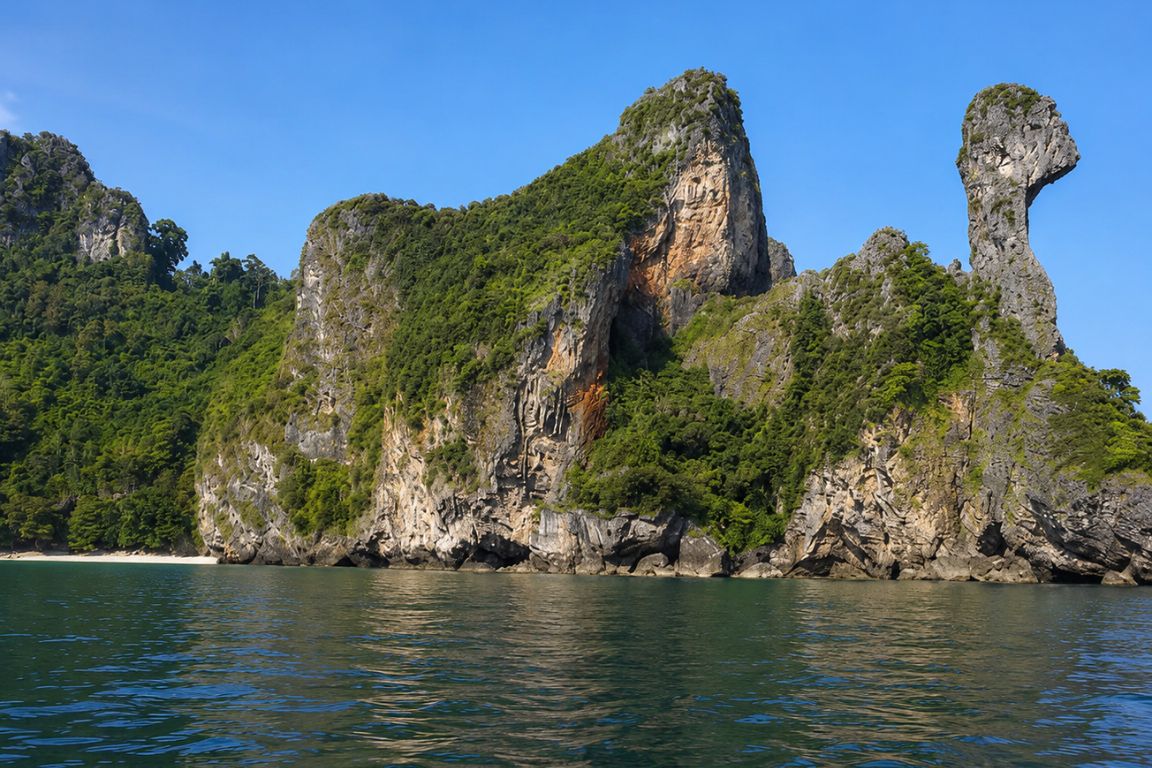
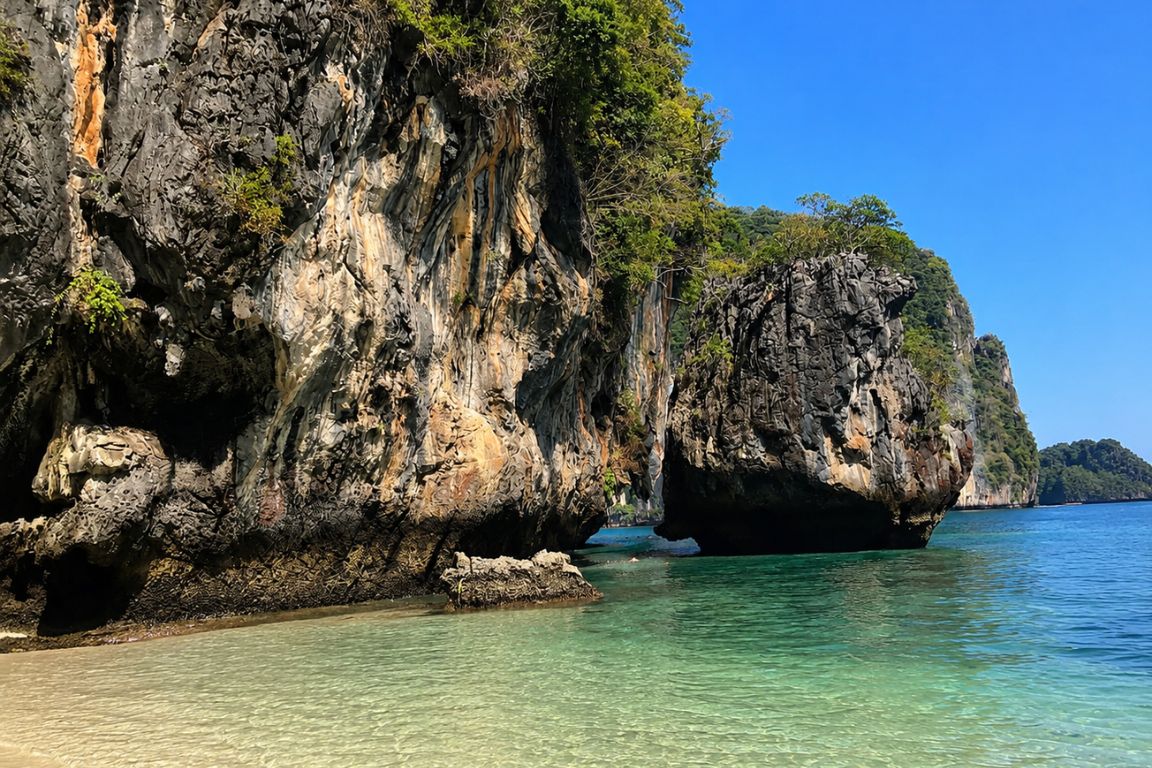
The limestone was laid down under a shallow tropical sea, then attacked from below for hundreds of thousands of years by slightly acidic water working along cracks. Caves formed, widened, and in many cases lost their ceilings. What remains above the waterline is the hard skeleton of that process: vertical cliffs, undercut bases where the tide has notched the rock, and interior spaces nobody outside can see.
Krabi sits at the northern edge of the same limestone system, which is why the coastline around Ao Thalane and Bor Thor behaves exactly as the bay islands do. The cliffs climbers use at Railay, the lagoon at Hong, the cave rivers north of Ao Nang and the spike at Khao Phing Kan are all one geology at different stages of collapse.
That continuity matters for planning. It means you can get the bay's defining experience, a tunnel opening into a cliff-ringed chamber, without necessarily committing to the long road transfer a Phang Nga day trip from Krabi requires. Whether you should is the question this guide answers.
| Detail | Info |
|---|---|
| Where it is | The bay between Krabi and Phuket, on Thailand's Andaman coast |
| Karst islands | More than forty, many hollow inside |
| Headline stop | Khao Phing Kan and the Ko Tapu spike |
| Signature activity | Sea canoeing into hongs, the enclosed open-sky chambers |
| Water character | Sheltered and shallow, calmer than the open Phi Phi crossing |
| From Krabi | About 90 min by road to a Phang Nga pier, then 30 to 45 min by boat |
| Typical day length | 8 to 9 hours from Krabi, about 8 from the Phuket side |
Park-fee treatment varies by tour; check what your selected listing includes.
What Do Phang Nga Bay Tours Actually Cover?
Bay itineraries vary. One supported longtail day names James Bond Island, Koh Panyi and Wat Suwan Kuha, with kayaking dependent on the option selected. The caves take more of the day than the film island does.
Koh Panak is the island most often named as the reason to come. It holds several separate systems, including a cave dense with roosting fruit bats, one named for stalactites that throw light around, an oyster cave and a mangrove passage. Each connects through a tunnel to an interior hong, and the largest of those chambers have hundred-metre walls with resident wildlife: macaques, water monitors, kingfishers, sea eagles.
Koh Panyi is the cultural stop and it is more interesting than the buffet suggests. The village stands on stilts over the water against a cliff, with a mosque, a school and a floating football pitch that has its own small legend, and it was a working fishing community long before it was a lunch stop. Covered shoulders is the right call while you walk through it.
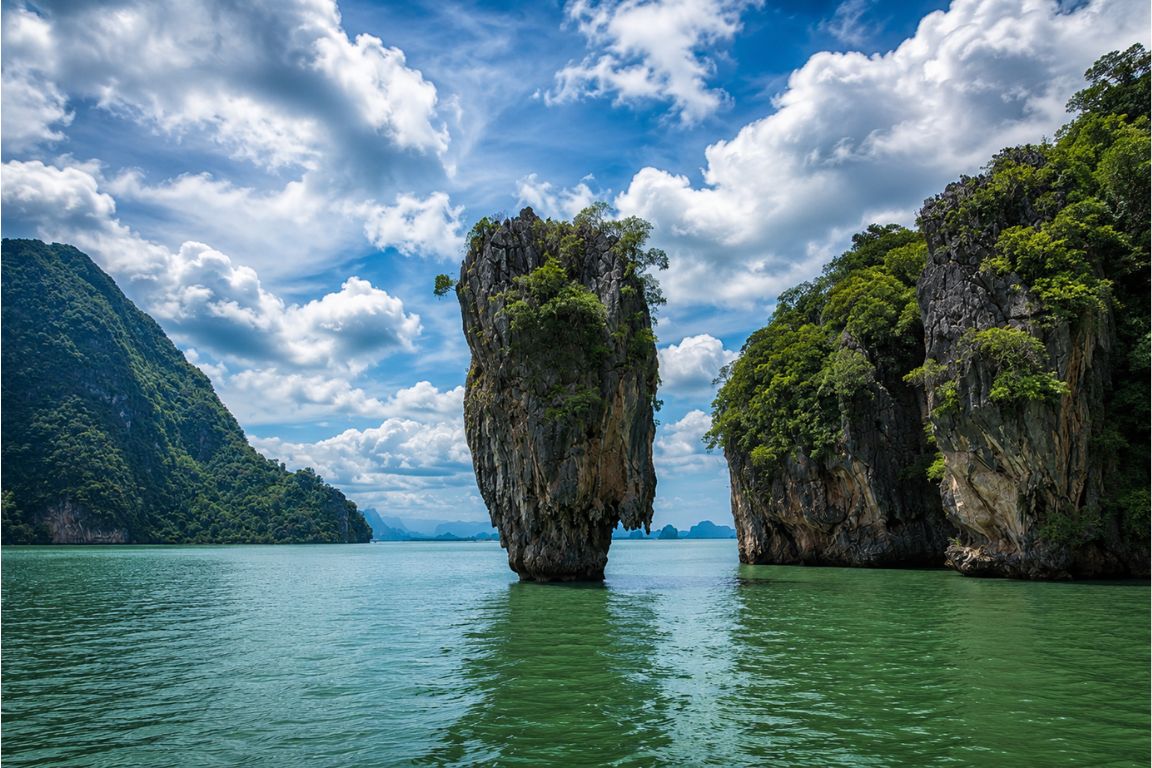
Khao Phing Kan gets 30 to 60 minutes, which is enough. The stop is a landing, a causeway walk past souvenir stalls, the photograph, back to the boat. Our destination guide to James Bond Island from Krabi covers that half hour in detail, including when the pier gets congested and how to be somewhere else by then.
What Does a Phang Nga Bay Day Look Like Hour by Hour?
Pickup and meeting times vary by route and hotel area, the boat is moving by mid-morning, the caves fill the late morning, lunch runs at the floating village, and the landmark stop and final swim carry the afternoon. From Krabi you are back at your hotel late afternoon; from the Phuket side, an hour or so earlier.
The morning is the part worth protecting. Every operator in the bay wants to be at the cave islands before the flotilla, which means the boats that leave first get the quiet tunnels and the boats that leave last queue for them. Being ready before your stated pickup time helps avoid delaying the group, but crowd levels cannot be guaranteed.
Midday belongs to lunch and to the landmark. Both are scheduled around the same window for most operators, which is why the pier at Khao Phing Kan is at its worst between roughly ten and one. A guide with any latitude will invert that sequence when they can, eating early or late and taking the island at an odd hour.
The last hour is usually the swim, and it is the stop people skip in their heads when they book, then rate highly afterwards. After a morning of sitting in a canoe with a camera, twenty minutes of floating off a sand beach is what turns a sightseeing schedule back into a day out.
| Time | What is happening | Where the day can slip |
|---|---|---|
| 07:30 to 08:30 | Hotel pickup, transfer to pier or marina | Late lobby arrivals push the whole group back |
| 09:00 to 10:00 | Boarding, safety brief, run out to the first cave island | Sea state can reroute the running order |
| 10:00 to 12:00 | Canoe legs through the caves and hongs | Tide height decides which caves open |
| 12:00 to 13:30 | Landmark stop and buffet lunch at the village | Busiest window at the pier |
| 13:30 to 15:00 | Beach stop, swimming, last photographs | Cut short if the morning ran late |
| 15:00 to 17:00 | Return transit, road leg if Krabi-based | Traffic on the Phang Nga road in peak season |
Speedboat, Longtail or Canoe-focused: Which Format Suits the Bay?
Speedboats cover the most ground and are the only realistic way to fit five stops into a day. Longtails are slower, quieter and gentler on the body, better for a shorter route at a relaxed pace. Some cave-focused trips skip the landmark and spend the day inside the caves, which is the bay's best material.
The choice is really about what you want to be doing during the middle four hours. A speedboat day is a sequence: move fast, stop, move fast, stop. It delivers variety and a lot of photographs, and the crossings are short enough that nobody gets restless. It also slams in any chop, which is why pregnant travellers and anyone with back or neck problems get steered away from it.
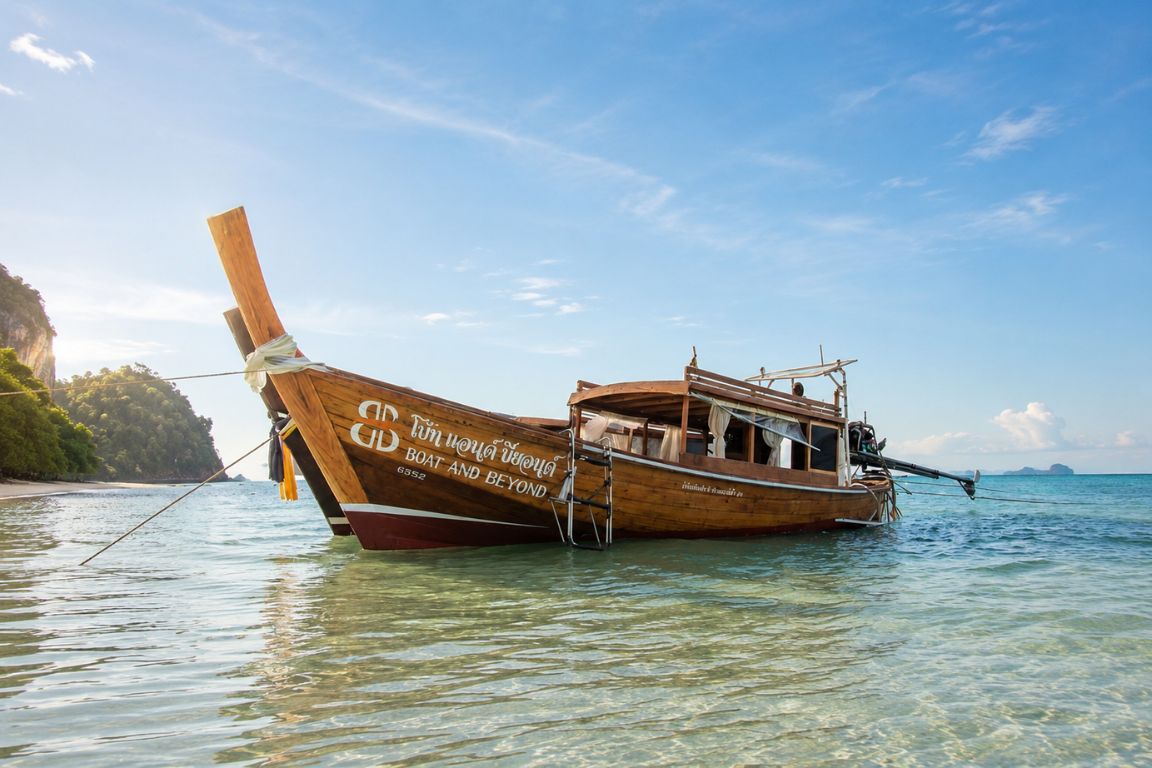
A longtail day trades reach for texture. The boat sits low, moves at a pace where you can hear the water, and the stops feel unhurried because there are fewer of them. On the Krabi side that format is why our private 4 Islands longtail charter runs the length of a day rather than a fixed circuit. The trade-off is honest: you will not reach the far side of Phang Nga and back on a longtail from Ao Nang.
A canoe-focused day is the format most people underrate. Half and full days at Ao Thalane and Bor Thor sit in the same limestone system, start 20 to 60 minutes from Ao Nang instead of two hours, and spend the whole time in tunnels, canyons and mangrove channels. If you want the mechanics of hull choice, our comparison of longtail vs speedboat travel lays them out.
| Format | Reach | Pace | Best for | Watch out for |
|---|---|---|---|---|
| Speedboat day trip | Full bay, 4 to 5 stops | Fast, scheduled | First-timers who want everything in one day | Slams in chop, not for back or neck problems |
| Longtail day trip | Shorter route, fewer stops | Slow, flexible | Relaxed days, photography, small groups | Will not cover the far bay from Ao Nang |
| Canoe-focused half day | One cave area | Very slow, guided paddle | Caves, mangroves, wildlife, families | No Ko Tapu, no landmark photo |
| Canoe-focused full day | Two cave areas plus lunch | Slow with a long break | Anyone who came for the hongs | Not every operator runs the northern route |
| Private charter | Set by you | Whatever you want | Groups, families, awkward tide windows | Priced per boat, not per person |
How Do the Sea Caves and Hongs Actually Work?
A hong is an open-sky chamber inside a karst island, reachable only through a tunnel at the right water level. Tide decides everything: too high and the tunnel ceiling closes, too low and the passage runs dry. On most tours a paddler handles the canoe through the dark sections, so no experience is needed.
Inside a tunnel the ceiling drops until you are lying back flat while the paddler pulls the canoe forward hand over hand on the rock above. That lasts a minute, maybe two. Then the passage opens and the chamber arrives all at once: cliffs going straight up, a circle of sky, still green water, air two or three degrees cooler than the open bay. The sound changes before anything else does.
Because the tide runs the schedule, an operator's tide-table discipline is the difference between entering a cave and looking at its entrance from outside. Ask at booking which cave is planned and at what state of tide. A guide who reshuffles the itinerary on the morning is doing the job properly. Our dedicated page on sea-cave canoeing sets out the three main areas reachable from Krabi and what each is best at.
Those Krabi-side options are worth knowing before you book a long transfer. The Bor Thor sea-cave kayaking tour runs an hour north of Ao Nang into cave rivers whose walls carry prehistoric paintings, and the deep-mangrove and canyon kayak tour runs for four hours.
| Cave area | From Ao Nang | Signature feature | Suits |
|---|---|---|---|
| Ao Thalane Bay | 20 to 25 min by road | Mangrove channels, canyon walls, macaques | Half day, families, wildlife |
| Bor Thor | About 60 min by road | Cave rivers with prehistoric wall paintings | History, dramatic tunnels |
| Hong Lagoon | 20 to 45 min by boat | Enclosed emerald lagoon, kayak access at low tide | Combining with an island day |
| Koh Panak, Phang Nga | 90 min road plus 30 to 45 min boat | Bat cave, stalactite cave, 100 m cliff hongs | The most dramatic chambers in the region |
How Much Does a Phang Nga Bay Tour Cost?
Combined Phang Nga tours from Krabi run 1,300 to 2,900 THB per person, road transfer included. Krabi-side cave kayaking is cheaper: 895 to 1,200 THB for a half day and 1,500 to 2,500 THB for a full day. Park fees may be included or charged separately, depending on the selected tour.
Compare group size, route, transfers, park-fee treatment and option-specific inclusions for your date. From the same launch point, the cheaper option usually means a bigger group, a tighter schedule and less time in each cave. The dearer one usually means a smaller boat and a guide who will change the route when the tide or the flotilla says so.
Cash discipline matters here more than on a beach day. The fee for Ao Phang Nga National Park is collected on the water, and drinks at the stops, souvenirs in the village and tips for the paddlers all run on notes. Nobody at a cave entrance takes a card.
For a like-for-like view against the Krabi island circuits, our complete Krabi boat tours guide puts every format the region sells on one page with the price bands attached.
| Option | Price band | What it includes |
|---|---|---|
| Phang Nga combined day from Krabi | 1,300 to 2,900 THB | Road transfer, boat, canoe legs, lunch |
| Speedboat with canoeing and lunch, Phuket side | Check the live listing for your travel date | Pickup, canoe guide, buffet lunch, live prices on the listing |
| Ao Thalane half-day kayak | 895 to 1,200 THB | Hotel pickup, guide, kayak, life jacket |
| Full-day kayak with lunch | 1,500 to 2,500 THB | Two cave areas, lunch, transfers |
| Bor Thor cave kayak | 1,200 to 1,800 THB half day | Northern cave rivers, transfer included |
| National park fees | 200 to 300 THB per adult | Check whether park entry is included before deciding how much cash to carry |
Can You See Bioluminescent Plankton in the Bay?
Not on a Phang Nga day trip. Those run in daylight and are back at the pier well before dark. Night plankton swims are separate Krabi evening activities, and the natural glow depends on conditions and is not guaranteed.
The confusion is understandable, because the geology is identical and the photographs look similar. The practical difference is timing. A bay day ends around four in the afternoon; plankton needs full darkness, which means a boat leaving in the late afternoon and swimming after sunset. No standard Phang Nga itinerary is built that way.
If the glow is on your list, treat it as a separate evening rather than an add-on. Our guide to bioluminescent plankton in Krabi covers the months, the moon phases and whether getting in the water is a sensible idea, and this site runs two night tours built around it.
Daytime marine life in the bay is a different question with a better answer. Sheltered water and mangrove edges hold more than the open crossings do, and our page on marine life in Krabi covers what turns up where.
When Is the Best Time for a Phang Nga Bay Tour?
November to April is the dependable window, with January to March the clearest. The bay's sheltered water means trips run through much of the monsoon as well, especially on June to August mornings. September and October carry the highest disruption risk of any Andaman boat day.
Krabi's dry season runs mid-November through April and delivers flat water, high visibility and every route operating. December and January bring peak crowds along with peak conditions, February the lowest humidity, and April the best value of the dry months, with accommodation well below peak while the sea stays calm.
The monsoon picture is more usable than its reputation. From June through August the typical day is a clear morning, sun until early afternoon, one or two hours of heavy rain, then clearing. Morning departures work. September and October are the genuinely wet months, averaging around 355mm and 338mm of rain and carrying a high same-day cancellation rate. The month-by-month view sits in our page on Krabi in the rainy season.
| Months | Conditions | Crowds | Verdict for the bay |
|---|---|---|---|
| November to December | Settling into dry, then excellent | Rising to very high at New Year | Book well ahead for late December |
| January to February | Outstanding, lowest humidity in February | High | Best water clarity for cave photography |
| March to April | Very good, heat building | Medium, then low | Best value dry-season window |
| May | Transitional and unpredictable | Low | Flexible bookings only |
| June to August | Clear mornings, afternoon downpours | Low | Morning departures run most days |
| September to October | Heavy sustained rain | Lowest | High cancellation risk, keep a spare day |
How Do You Avoid the Crowds in the Bay?
Leave first, eat off-cycle, and pick an operator who will change the running order on the morning. The bay is big and the boats are not spread across it: they move in a loose convoy through the same three or four places at the same hours, and stepping out of that rhythm is entirely possible.
Departure time does most of the work. The tunnels at the cave islands are single-file spaces, so a hong that feels enormous with one canoe in it feels like a car park with nine. Boats that clear the pier early get the first pass. Everything downstream of that, including how long your paddler will linger inside a chamber, follows from it.
The second lever is lunch. Because almost every itinerary eats at the same village in the same middle hour, the operators who eat early or late get the landmark stop while the rest are still at the buffet. Ask directly whether the guide has the latitude to reorder the day. The good ones say yes without hesitating, and describe exactly when they would use it.
The third is the season, and it is the bluntest of the three. Late December and January put the most boats in the bay at once. March and April keep the conditions and lose a large share of the traffic, and the early monsoon months from June to August are quieter again on any morning the weather holds. Booking a shoulder month is a more reliable crowd strategy than any amount of clever scheduling inside a peak week.
Who Should Book a Phang Nga Day, and Who Should Not?
Book it if you want caves, the film landmark and forty karst islands in one day and you have the hours to spend. Skip it if you have one free day in Krabi, a bad back, or a child under three, and take a Krabi-side cave or island day instead.
Time is the honest filter. Transit varies by route: conventional mainland approaches include road travel, while one supported eight-hour speedboat route travels by sea from Krabi. That is a fine trade on a second or third boat day and a poor one on your only day out. A traveller with a single free day gets more water time from the inner circuit, and the planning logic behind that sits in our Krabi itinerary guide.
Physical limits are the second filter, and they come from the operators rather than from us. Speedboat transits are not recommended for pregnant travellers or people with back problems, children under three are not accepted on the tour listed here, and Accessibility varies by outing and should be checked for the exact product selected. A private longtail offers a slower private format, but its health restrictions still apply.
If the caves are the draw and the transfer is the obstacle, the answer is simple. Paddle Ao Thalane or Bor Thor instead, keep the rest of your day, and do the bay properly on a trip when you have a night on the Phuket side. Any Krabi island tour operator worth booking with will tell you the same thing.
| Traveller | Best fit |
|---|---|
| First visit, two or more boat days | Full bay day by speedboat |
| One free day, Krabi-based | Ao Thalane kayak or an inner-circuit island day |
| Cave and wildlife focus | Bor Thor full day, or Ao Thalane half day |
| Family with young children | Sheltered kayak routes, not the speedboat day |
| Back, neck or heart condition | Longtail or private charter, avoid fast hulls |
| Photographers | Longtail or private charter, early departure |
| Staying on the Phuket side | Sea-only bay day, no road leg at all |
Frequently Asked Questions
How far is Phang Nga Bay from Krabi?
About 60 kilometres in total, but not in a straight line. Tours run roughly 90 minutes by minivan to a Phang Nga pier, then 30 to 45 minutes by boat into the bay. From the Phuket side the same water is about 40 minutes by speedboat with no road leg, which is why Phuket departures spend more of the day on the water.
What is a hong?
Hong is Thai for room, and that is what it is: an open-sky chamber inside a limestone island, ringed by cliffs and reachable only through a tunnel at the right tide. The largest chambers in Phang Nga have walls up to a hundred metres high with their own resident macaques, monitors and sea birds.
Do you need kayaking experience?
No. On most Phang Nga cave tours a paddler handles the canoe through the tunnels while you sit and duck. Krabi-side kayak trips at Ao Thalane and Bor Thor hand you the paddle, but they are beginner routes in sheltered water and start with a short technique briefing before you launch.
Is Phang Nga Bay better than the Krabi island tours?
It is different rather than better. Phang Nga gives you caves, the film landmark and the biggest karst scenery, split across five short stops either side of a long transfer. A Krabi island day gives three to six hours of swimming, lagoons and beaches twenty minutes from the pier. Two days covers both properly.
Can you do Phang Nga Bay in the rainy season?
Often yes, especially June through August when mornings are usually clear. The bay is more sheltered than the open Phi Phi crossing, so it survives conditions that cancel other trips. September and October are the difficult months, with heavy sustained rain and a high same-day cancellation rate.
How much cash should you carry?
At least 300 THB per adult for the national park fee, plus small notes for drinks, souvenirs at the village stop and a tip for your paddler. Carry cash for separately listed fees and small purchases, and there is nowhere useful to change money once the tour has started.
Check your actual travel date before arranging anything else
Match the outing to your plans
Blank fields keep the initial suggestion. Age pricing alone does not confirm suitability; if eligibility is unverified, the tool will not recommend a match. Check pickup and restrictions for your selected package.
Compare two total quotes
Use current quotes in the same currency, including park fees, transfers and option extras.
Initial recommendation. Adjust the optional choices to match your plans.
Krabi to James Bond and Hong Islands Offbeat Speedboat Tour
See how a direct-sea speedboat combines three island areas, snorkeling, beach lunch and included park fees in one day.
8h · English guide listed · · Confirm your selected option’s pickup, inclusions, fees and participant restrictions before booking.
Choose a date to view the published schedule. Confirm availability and final price on Viator.
No reviewed option matches these choices.