Bioluminescent Plankton in Krabi: Where and When to See It
Krabi's glowing water is real, it is plankton, and it is never guaranteed. Three of the night trips running out of Ao Nang finish in the dark at Phra Nang Cave Beach or off Ko Rang Kai, where one kick of the legs throws out a spray of cold blue sparks. What decides how much you see is moon phase, cloud cover, and how patient you are about letting your eyes adjust.
What follows an island sunset? This wooden-junk cruise continues to a bioluminescent swim near Railay. Explore 4 Islands Sunset Snorkeling.
Booking choice: Compare a wooden-junk cruise combining island snorkeling, dinner, sunset and a Railay plankton swim. Check dates for 4 Islands Sunset Snorkeling.
What Actually Makes the Water Glow?
Single-celled plankton called dinoflagellates do it. Each cell runs a chemical reaction that fires a flash of blue-green light when the water around it is disturbed. One cell is invisible. Millions of them held in a warm, sheltered bay turn every kick, paddle stroke and boat wake into cold blue sparks.
The chemistry is unremarkable: a light-emitting molecule, an enzyme that oxidises it, a flash lasting a fraction of a second. Biologists have a long-standing explanation for why the plankton bother, sometimes called the burglar alarm idea. A flash advertises whatever is eating the plankton, and advertising attracts something bigger. Whether or not that is the full story, the practical consequence is the same one you will meet in the water: bioluminescence in these organisms answers to movement, not to the hour on the clock.
Still water looks like ordinary black sea. Move through it and the outline of your own forearm lights up. That is also why the sea never glows evenly the way heavily edited photographs suggest. You are not swimming across a lit pool. You are dragging a trail behind you that fades in about a second, then dragging another one. On a strong night the closest comparison is sparks coming off a struck match. On a weak night it is a thin scatter you only notice when you cup your hands underwater and pull them apart.
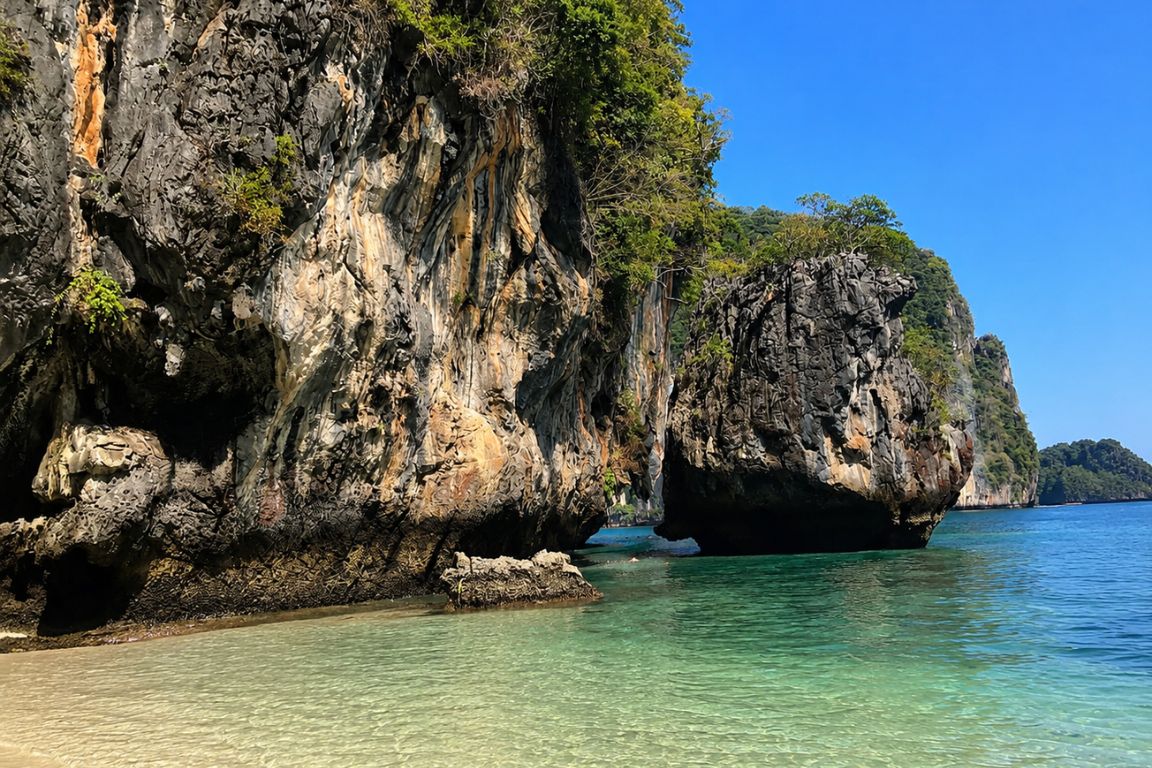
Concentrations build where warm surface water sits more or less still against land, which is why bays tucked under limestone headlands beat open channels. The same nutrient-rich coastal water feeds the reef fish, parrotfish and blacktip reef sharks described on our page about marine life around Krabi. Glowing plankton are not a separate exotic phenomenon bolted onto the Andaman. They are the bottom of the same food chain, doing something you can only see once the sun has gone.
Where Do Krabi Night Tours Actually See It?
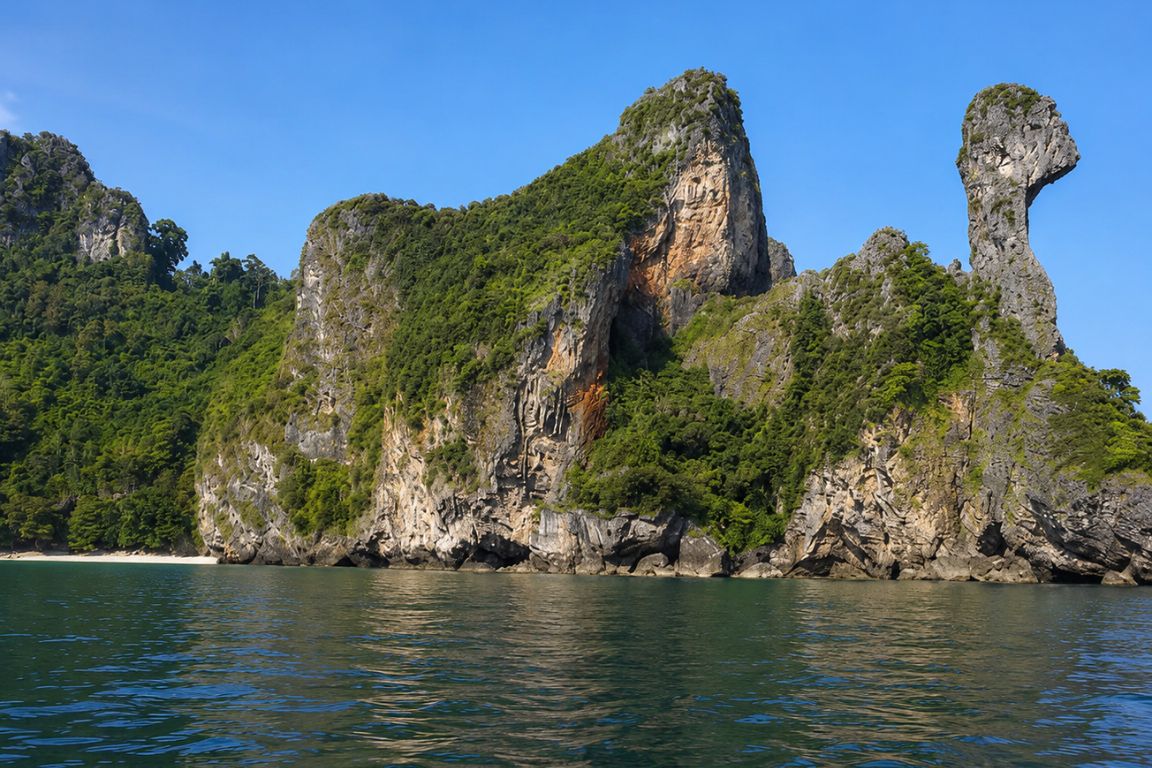
Two anchorages carry almost all of it: Phra Nang Cave Beach under the Railay headland, and the water off Ko Rang Kai beside Chicken Island. Both are shallow, sheltered, and shielded from town lights by rock. Crews go back to them rather than stopping wherever the boat happens to be when the light fails.
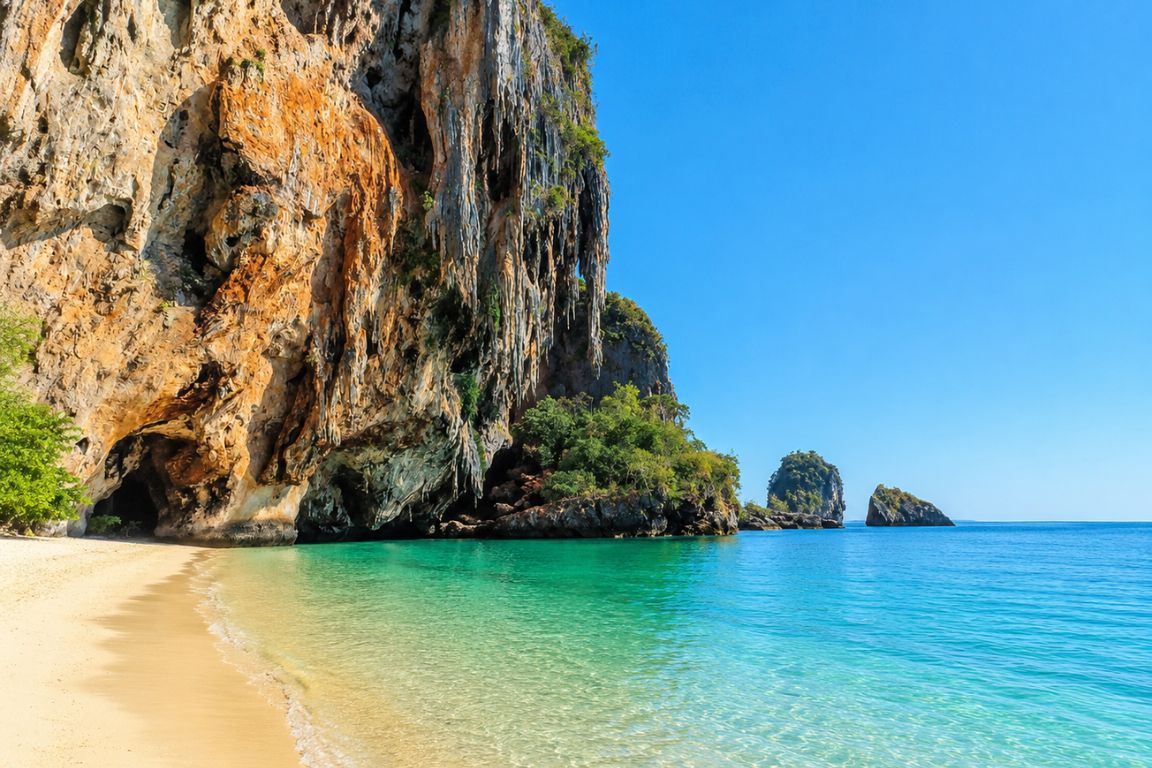
That choice is not sentimental. A good night site needs three things at once: enough depth to swim but little enough that you can stand up, a sand or seagrass bottom instead of urchin-covered rock, and a wall of limestone between you and the lit-up restaurant strip. Phra Nang has all three, which is one more reason the beach is worth a daylight visit too, covered in the Railay Beach guide. Railay is walled off by cliffs and reachable only by boat, so the ambient light there drops away fast.
| Night trip | Length and start | Format | Where the glow leg happens | What fills the daylight half | Guide price |
|---|
Private junk-boat sunset and bioluminescent night snorkel 8 hours Private 100-year-old junk boat with a roof deck, paddleboards and a kayak Bioluminescent night snorkel Custom route, snorkeling support and Thai buffet dinner Check the live listing for current private-booking cost
Private Hong Islands and optional 4 Islands sunset night snorkel 7 to 9 hours, pickup 10:45 in Ao Nang Private longtail with a certified guide The upgraded option adds 4 Islands, sunset at Phra Nang and bioluminescent night snorkelling Hong Islands, lagoon, snorkelling and lunch Check the live listing for current private-booking cost
7 Islands sunset cruise with beach BBQ 7 to 8 hours, pickup 12:30 to 13:30 Shared traditional longtail Evening bioluminescent-plankton experience Island swimming and snorkelling, sunset and BBQ dinner Check the live listing for current cost and inclusions
The pattern in that table is the thing to take away. The strongest options compared here combine the plankton stop with a broader island outing, giving the evening snorkeling, sunset or dinner beyond the natural glow. What the local fleet sells instead is a full island day whose last hour happens to be after dark. If the glow is weak that evening you have still had the sandbar, the snorkelling and the sunset. The night trips compared here pair the plankton experience with a broader island itinerary. Related reading: boat tours from Krabi
Departures cluster in one place. The join tour includes an Ao Nang shared shuttle; the private longtail includes Ao Nang hotel transfers, while the private junk uses Ao Nang or Railay meeting points and charges extra for hotel transfers. If you are choosing a base partly around evening boats, the Ao Nang beach and departures guide lays out which pier serves what.
What Month Is Best for Bioluminescence?
November through April, with January to March the sweet spot. The plankton live in Andaman coastal water all year. What the dry season adds is calm sea, clear sky and boats that actually sail, and those three decide whether you get in the water at all.
This trips people up, so it is worth being blunt about the mechanism. Nothing seasonal switches the plankton on. Blooms come and go on a scale of days, driven by water temperature, nutrients and how still the surface has been. What the southwest monsoon does, roughly May through October, is stack the odds against you in three separate ways at once: heavier cloud over the sky you need dark, choppier water that scatters the boat's own wake into nothing you can pick out, and a real chance the operator cancels the evening leg on a safety call. Our pages on Krabi in the rainy season and when Krabi boat tours run best go deeper into the sea-state side of that.
| Month | Sea state for a night stop | Sky and cloud | Crowding on the sunset run | Verdict for the glow |
|---|---|---|---|---|
| January | Calm, reliable | Clearest of the year | High, book ahead | Best overall, pick a new-moon week |
| February | Calm | Very clear | High | Best overall |
| March | Calm, warm water | Clear, some haze late month | Easing | Excellent and slightly quieter |
| April | Usually calm, hot | Hazy afternoons, clear nights | Songkran spike mid-month | Good, avoid the festival week if you want space on the boat |
| May | Turning, first squalls | Building cloud | Low | Coin flip, cheap but cancellable |
| June and July | Choppy, swell days | Frequent cloud | Low | Poor odds, treat any glow as a bonus |
| August and September | Roughest stretch | Heaviest cloud and rain | Lowest | Weakest window, evening legs get pulled |
| October | Improving late month | Clearing in patches | Low | Gamble early, decent by the last week |
| November | Settling, good by mid-month | Clear stretches | Rising | Season opens, good value |
| December | Calm | Clear | Peaks at New Year | Strong, but book weeks out |
Inside a good month, the day-to-day variable is still weather, and the Thai Meteorological Department publishes the Andaman marine forecast at tmd.go.th if you want to check a specific evening. One more scheduling note that has nothing to do with plankton: national park fees apply at several of the daylight stops on these routes, from 200 to 400 baht per adult depending on the park, usually cash, and sometimes already folded into a private booking. Confirm which applies on the live listing before you go.
How Much Does the Moon Matter?
More than the month does. A full moon in a clear sky throws enough light on the surface to wash out a faint blue flash completely. The nights either side of a new moon are the ones worth planning around, and the rule crews work to is simple: the darker the sky above you, the brighter the sea below.
You can plan this months ahead, because moon phase is arithmetic rather than weather. Pick your new-moon week first, then pick your dates. If your trip is locked and lands on a bright moon, the fallback is timing rather than luck. The moon rises roughly fifty minutes later each night as it waxes, so in the days after new moon the sky stays properly dark through the early evening even though the moon eventually appears. A night stop at 19:30 can be genuinely black on a date whose moon does not clear the karsts until well after you are back at the hotel.
| Moon phase | Sky brightness at the anchorage | What the plankton look like | Book that night? |
|---|---|---|---|
| New moon, plus two nights either side | Darkest available | Clear sparks off hands, feet and the hull wake | Yes, the target window |
| Thin crescent | Nearly as dark, moon low or already set | Close to new-moon quality | Yes |
| First or last quarter | Half-lit sky, obvious shadows on deck | Visible but muted, needs full dark adaptation | Workable, sit on the shaded side of the boat |
| Gibbous | Bright enough to read a menu | Faint, mostly in the hull shadow | Only if the moon rises late |
| Full moon, clear sky | Brightest, karsts fully lit | Usually washed out | Go for the sunset and the dinner, not the glow |
| Full moon, heavy cloud | Dark by accident | Can be surprisingly good | Worth a shot if you are already booked |
Cloud is the wildcard that cuts both ways, and that last row is not a joke. Overcast kills the stars but also blocks the moon, and a plankton bloom does not care whether the sky is pretty. Some of the strongest nights people describe come on flat, muggy, starless evenings when nobody expected anything.
Is Bioluminescent Kayaking Worth It?
It is worth it if you want the light show without getting into black water, and it is the weaker version if you do want to swim. A paddle blade pulls a bright ribbon through the surface and the hull throws a glowing wake, but from a seated position the effect is a line beside you rather than sparks wrapped around you.
There is a Krabi-specific wrinkle worth knowing before you go searching for a booking. The famous dedicated bioluminescent kayak tours belong to other places, the mangrove lagoons of Puerto Rico and the Florida lagoons among them, where the bloom is dense, permanent and legally protected. Krabi does not work that way. Kayaking here is a daylight product built around mangrove channels, hongs and sea caves, the sort of trip covered in our sea cave canoeing guide, while the after-dark product is a swim or a snorkel off an anchored boat. If a listing promises you a purpose-built bioluminescent kayak trip in Krabi, read the itinerary twice.
What you can get is a paddleboard or kayak on a private boat that carries them. The junk-boat trip carries six paddleboards and a two-person kayak, but nighttime use during the plankton stop is not stated.
| How you view it | What you actually see | Best for | Trade-off |
|---|---|---|---|
| Snorkel or swim | Sparks off every limb, a glowing cloud when you sweep an arm, trails off your fins | The full effect, confident swimmers | Black water at night unsettles some people |
| Paddleboard or kayak | A bright ribbon off the blade, glow along the hull, sparks when you dip a hand | Non-swimmers, nervous swimmers, anyone who wants to stay dry | Roughly half the intensity of being in it |
| From the deck, boat drifting | Wake glow and whatever the swimmers stir up below you | Kids, older travellers, photographers on a tripod | Passive, and deck lights ruin it unless the crew kills them |
| Wading from the beach | Sparks around your ankles and shins in the shallows | Testing the water before committing | Weakest version, and beach light spill is a problem |
| Hands only, over the side | Cup and pull apart underwater for a small blue puff | Confirming a bloom is present at all | A diagnostic, not an experience |
Why Can't You Swim in Bioluminescent Water?
Usually you can, and in Krabi you do. That question comes from other parts of the world where the glow is a red-tide bloom that irritates skin and lungs, or where the lagoon is a protected reserve that bans entry outright. Neither situation applies to the sheltered night stops these boats use.
Three real reasons swimming gets banned elsewhere, and it is worth separating them, because only one is about the plankton being dangerous.
The first is harmful algal blooms. Some dinoflagellate species produce toxins, and a dense bloom can discolour water brown or red in daylight, kill fish, and make the air near shore unpleasant. A few of those species also glow. That combination, a visible daytime discolouration plus a fish die-off or a posted health advisory, is a genuine stay-out. It is not what an operator anchors over on a routine evening stop.
The second is conservation. The world's few permanently dense bioluminescent bays are fragile, and the standard protection is to keep bodies out of the water, because sunscreen, insect repellent and skin oils damage the organisms. Krabi's glow is diffuse and seasonal rather than a standing bloom in an enclosed lagoon, so the same rule has not been applied here. The underlying point still holds, though: rinse off sunscreen and repellent before you get in, and skip a fresh application right before the night stop.
The third has nothing to do with plankton at all. Night water is simply harder. You cannot see the bottom, you lose your bearings quickly, and boats moving nearby cannot see you. Everything the crew does at a night stop is aimed at that: anchoring in shallow water over sand, floating a light, keeping the group inside a marked area, putting a guide in the water, and having life jackets on hand. The junk-boat operator runs its night snorkel with crew support specifically so that beginners and non-swimmers can take part. If you tell the guide you are not a strong swimmer, that is useful information rather than an admission.
Is Bioluminescence Visible to the Human Eye?
Yes, with no filter, no app and no camera. The catch is your eyes rather than the sea. Full dark adaptation takes twenty to thirty minutes, and one look at a phone screen throws away a good part of it. People who report seeing nothing have often been staring at a bright deck light five seconds earlier.
Rod cells handle low light, and they need time to recover their sensitivity after any bright exposure. That gives you a short and slightly annoying protocol for the last hour of the trip. Put the phone away as the sun goes down, or at minimum drop the screen to its lowest brightness and switch on the red-tinted night filter most phones now include. Sit on the unlit side of the boat. Do not use a torch to find your fins. Look at the water immediately beside you rather than out at the horizon, because peripheral vision picks up faint light better than the centre of your gaze does.
| What you do | Weak night | Typical night | Strong night |
|---|---|---|---|
| Cup hands underwater and pull them apart | A few scattered specks | A small blue puff | A bright flare between your palms |
| One kick below the surface | Barely anything | A short trail off each foot | Two glowing arcs that hang for a second |
| Wake off the hull as the boat repositions | Faint edge along the waterline | Clear glowing line | A luminous stripe you can photograph |
| Sand stirred with a hand in the shallows | Nothing | Sparks in the disturbed cloud | The whole cloud lights blue |
| Full-body swim | Occasional flecks on your skin | Outlined arms and legs | Your entire body traced in blue, sparks off every finger |
Set expectations at the typical column, not the strong one. The strong nights are real and they are what the videos come from, but they are the tail of the distribution and no operator can promise you one.
Is It Safe to Touch Bioluminescence?
Touching the plankton is harmless at these sites. They are microscopic, they do not sting, and the light is a cold chemical reaction with no heat in it. What deserves your attention is everything else in warm night water: jellyfish, urchins on rock, and your own footing on a bottom you cannot see.
Take the plankton question first, because it has a clean answer. Handling glowing water does not burn, sting or stain. The species that carry real risk are the toxin producers in harmful blooms, and those declare themselves in daylight through discoloured water, dead fish or a posted advisory. A guided evening stop at a site the crew uses week after week is not an opportunistic swim through a red tide.
Stingers are the more practical concern, and honesty serves you better than reassurance here. Thai beaches on both coasts post box jellyfish warnings and some access points keep vinegar stations, because incidents are rare but real. Vinegar is the standard first response on Thai beaches for a suspected box jellyfish sting, followed by getting medical help rather than waiting to see. A rash guard or a thin full-body skin suit is cheap insurance and also solves the cool-down problem on a long evening.
| Concern | Real risk on a guided night stop | What handles it |
|---|---|---|
| The plankton themselves | None | Nothing needed |
| Jellyfish stings | Low but genuine | Rash guard, crew vinegar, exit the water and tell the guide immediately |
| Disorientation in the dark | Moderate for first-timers | Stay inside the boat's light, wear the life jacket, swim with someone |
| Urchins and rock | Moderate near rocky edges | Stay over the sand, keep fins on, never stand on what you cannot see |
| Cold and fatigue | Low, night water off Krabi stays warm | Get out at the first shiver, dry off, the boats carry freshwater showers |
| Other boat traffic | Low at an anchored site | Never swim beyond the area the crew marks out |
How Do You Photograph Glowing Plankton?
Most phones will not get it, and a good share of what circulates online is composited or heavily pushed in editing. A camera with manual control, a fast lens and something solid to rest on can record it. Handheld phone video shot mid-snorkel comes back black almost every time.
The problem is physics rather than skill. Each flash is dim and lasts a fraction of a second, so you need a long exposure to collect enough light, and a long exposure needs the camera to be still. In the water you are the opposite of still.
| Setup | Aperture | Shutter | ISO | Focus | Realistic outcome |
|---|---|---|---|---|---|
| Phone, default camera app, handheld | Fixed | Auto | Auto | Auto, will hunt | Black frame |
| Phone with manual or night mode, braced hard on the rail | Widest available | 5 to 15 seconds | 3200 to 6400 | Manual, set to infinity | A faint blue trail if the boat is not rolling |
| Mirrorless or DSLR, fast wide prime, small tripod on deck | f/1.4 to f/2 | 10 to 25 seconds | 3200 to 12800 | Manual, prefocused at dusk | The best realistic result: a lit wake or a glowing paddle stroke |
| Action camera in the water | Fixed | Not adjustable | Not adjustable | Fixed | Almost never works, the flash is too brief and too dim |
Three things raise your odds more than any setting does. Prefocus while there is still light and then tape or lock the focus ring, because autofocus is useless later. Ask the crew to kill the deck lights for a few minutes, which they will usually do because it improves the swim for everyone. Then shoot the disturbance rather than the open sea: have someone drag a paddle or a hand through the frame on a count of three, or point the camera at the hull wake as the boat repositions, since that is the brightest and most repeatable glow available.
Also consider not photographing it. The strongest reports from these evenings come from people who put the phone in a dry bag at sunset and did not take it out again.
What to Bring on a Krabi Night Trip
Pack for a long day that finishes wet and dark, not for a beach afternoon. The three items people wish they had brought are a rash guard, a dry set of clothes, and a small red-light torch. Everything else is comfort.
| Item | Why it earns space | Skip if |
|---|---|---|
| Rash guard or thin skin suit | Sun cover by day, sting cover and warmth after dark | Never, this is the one to bring |
| Dry clothes in a sealed bag | You board wet at the end and the ride back is breezy | Never |
| Reef-safe sunscreen, applied early | Long exposure on deck, and early application means it has rinsed off by the night swim | Never |
| Small torch with a red mode | Finding gear without destroying anyone's night vision | You are happy to feel around in the dark |
| Cash in baht | National park fees at several daylight stops, drinks, tips | Your private booking already covers park fees, but bring some anyway |
| Prescription mask if you need one | Half the point of the night stop is seeing detail | The junk-boat trip carries prescription masks onboard |
| Light long sleeves for the ride home | Wet skin plus wind after sunset is colder than the air suggests | You run hot |
Motion sickness medication Ask a clinician or pharmacist about medication suitability. Skip only if you know small boats do not affect you
Who Should Skip the Night Snorkel
Skip it if you are anxious in open water, if you are travelling with small children who will be well past bedtime, or if your only free evening falls on a bright full moon. None of those is a small caveat, and a sunset cruise without the night leg is a better evening for all three.
The timing is the part people underestimate. The join tour picks up around midday and gets you back to the hotel somewhere near 20:00 to 21:00, and the private trips run eight to nine hours. That is a long day for a five-year-old, and the best part of it happens when they are already tired. If you are travelling as a family, the daylight island runs make more sense, and the sunset cruise options set out in our Krabi sunset cruises guide give you the golden hour without the late finish.
The other honest filter is expectation. If you are booking specifically and only to see glowing water, and you will count the trip a failure without it, wait for a new-moon week in the dry season, or accept that you are buying an island day with a possible bonus at the end. Anyone whose evening plans are more about dinner, a drink and a market wander will find the wider picture in our guide to what Krabi offers after dark, and Thailand's official tourism site at tourismthailand.org keeps a general Krabi overview alongside it.
A Night That Works, Start to Finish
The best-case version is a January or February date inside a new-moon week, on a private boat, boarding early afternoon and treating the plankton as the closing act of a full island day rather than the reason for it.
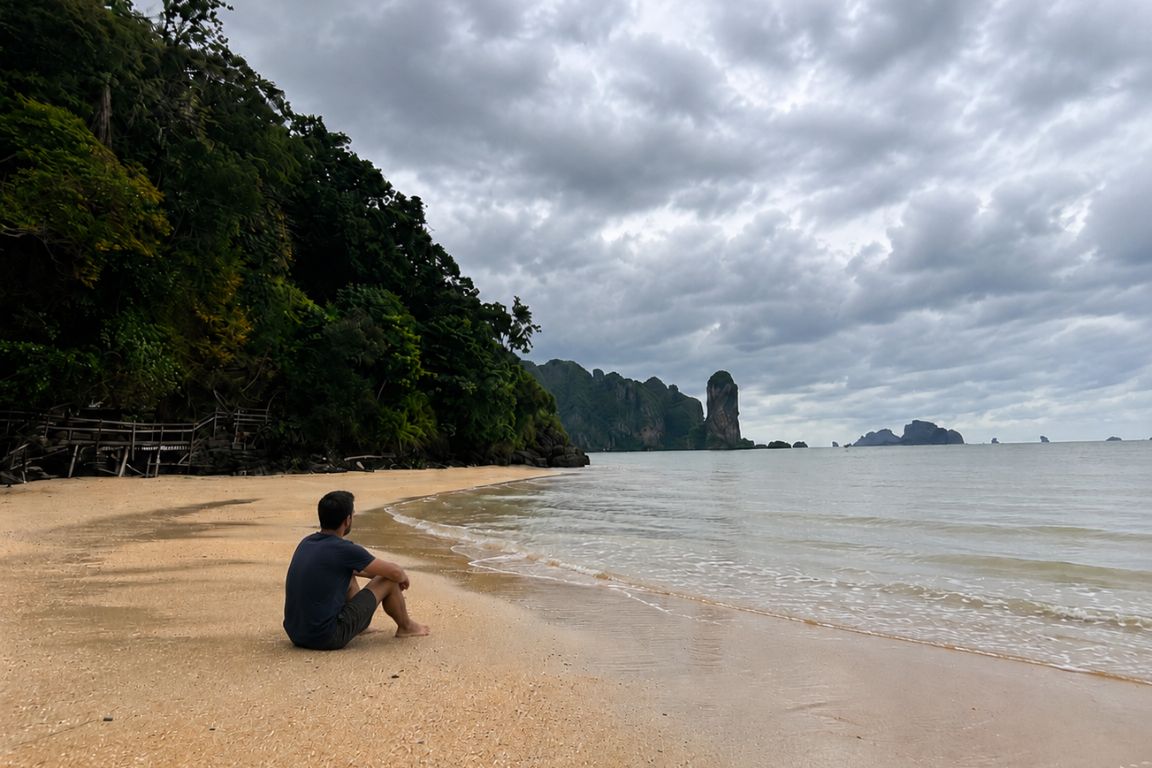
It runs roughly like this. Pickup in Ao Nang after lunch, an hour or two of snorkelling while the light is still good, then the sandbar or the lagoon depending on the tide. Dinner is eaten on the water, either a BBQ on Ko Poda or a buffet on the roof deck. You watch the sun go down behind the karsts, and then, in the flat hour after, the crew moves a short distance to the anchorage, cuts the lights, and lets everyone's eyes settle. Someone puts a hand in the water first. Then everyone gets in.
Book the boat early in your trip rather than on your last night. If the evening leg gets pulled for weather, or the moon is brighter than you hoped, you still have room to try again.
Frequently Asked Questions
What month is best for bioluminescence in Krabi?
January to March, inside the dry season, when calm seas and clear skies line up with boats that reliably sail. The plankton are present all year, but the southwest monsoon from roughly May to October brings cloud, chop and cancelled evening legs. Inside any good month, pick the week around a new moon.
Is bioluminescent kayaking worth it in Krabi?
Worth it as a dry alternative, weaker than swimming. A paddle blade drags a bright ribbon and the hull glows, but from a seated position you see a line beside you rather than sparks all around you. The compared private junk cruises carry paddleboards and a kayak, but nighttime paddling is not stated.
Why can't you swim in bioluminescent water?
In Krabi you can, and the night trips are built around swimming. The ban applies elsewhere: to harmful algal blooms that irritate skin and lungs, and to protected lagoons where sunscreen and repellent would damage a permanent bloom. Rinse off sunscreen before the night stop and follow the crew's marked swim area.
Is bioluminescence visible to the human eye?
Yes, with no camera or filter. Your eyes need twenty to thirty minutes of darkness first, and a single glance at a phone screen undoes much of that. Look at the water beside you rather than the horizon, keep deck lights off, and move a hand underwater to trigger the flash.
Is it safe to touch bioluminescence?
Yes. The plankton are microscopic, they do not sting, and the light is a cold reaction with no heat. The genuine night-water risks are jellyfish, urchins on rock and losing your bearings in the dark, which a rash guard, staying over sand and staying inside the boat's light all address.
Can non-swimmers join a bioluminescent night tour?
Often yes. The private junk-boat trip runs its night snorkel with crew support aimed at beginners and non-swimmers, life jackets are available, and the anchorages are shallow. Tell the guide before you board rather than at the ladder, and consider a paddleboard instead of getting in.
Do any Krabi tours guarantee you will see the plankton?
No honest operator does, and the trips are not sold that way. Bloom density shifts day to day. The listed seven-island trip pairs its attempted glow with island snorkelling, sunset and a beach BBQ, so the outing is not limited to the plankton stop.
Check your actual travel date before arranging the rest of Krabi
Match the outing to your plans
Blank fields keep the initial suggestion. Age pricing alone does not confirm suitability; if eligibility is unverified, the tool will not recommend a match. Check pickup and restrictions for your selected package.
Compare two total quotes
Use current quotes in the same currency, including park fees, transfers and option extras.
Initial recommendation. Adjust the optional choices to match your plans.
Krabi 4 Island Sunset Snorkeling Cruise + Bioluminescent Swim
Compare the Railay plankton swim with shared, private and sunset-only alternatives before fixing dinner, transfers or another island day.
6h–7h · English guide listed · Wooden-junk cruise with snorkeling and dinner, followed by a night swim; wildlife and natural glow vary. · Confirm your selected option’s pickup, inclusions, fees and participant restrictions before booking.
Choose a date to view the published schedule. Confirm availability and final price on Viator.
No reviewed option matches these choices.