Tiger Cave Temple, Krabi: the 1,260 Steps, Honestly
Wat Tham Suea sits on a limestone outcrop inland from Krabi Town, and the climb to the golden Buddha at the top is quoted at 1,260 steps. They are steep, uneven and fully exposed. Almost everybody who finishes says the same thing at the top, and almost nobody says it on the way up.
Curious how one nine-hour small-group circuit connects Tiger Cave Temple with Krabi’s inland pools? Explore Emerald Pool & Tiger Cave Day Trip.
The steps start out looking manageable. Wide, concrete, a handrail on one side, macaques watching from the wall. Somewhere around the two hundred mark the risers get taller and stop being uniform, the handrail becomes something you actually use, and the tree cover thins to nothing. That is the real character of this climb: not the number, the fact that the last third is the steepest part and it happens in full sun with your legs already gone.
Booking choice: A nine-hour small-group circuit combines Tiger Cave Temple, Emerald Pool and hot spring water. Check dates for Emerald Pool & Tiger Cave Day Trip.
How Many Steps Does Tiger Cave Temple Have?
The figure quoted on tour listings and by guides is 1,260 steps from the base to the summit shrine. They are not uniform. The lower flights are gentle enough to lull you, the upper flights climb steeply with tall, uneven risers, and the exposed section near the top is where most people stop counting.
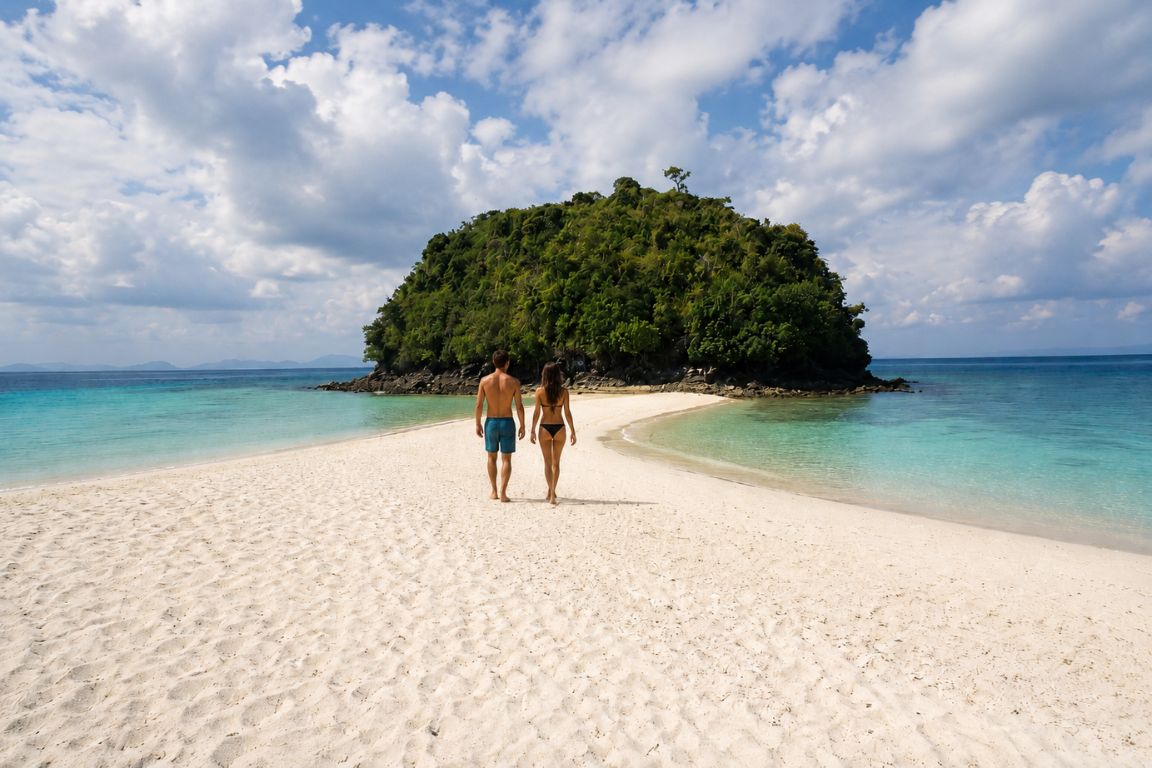
Take the number as the working figure rather than a survey. Counts posted around the site and repeated in guidebooks vary slightly depending on where a person starts counting and whether the short landings are included, and nobody at the summit checks your arithmetic. What matters more is the profile: the difficulty is stacked at the end, so the flight that beats people is rarely the one they were braced for.
The climb is a single staircase up the side of a karst outcrop, which means there is no alternative route, no cable car and no shortcut. You go up the way everyone goes up. There are landings where people rest, and on a busy morning those landings become a slow-moving queue of climbers deciding whether to continue.
Wat Tham Suea itself is a working temple and one of Thailand's more revered meditation centres, not an attraction built around a viewpoint. The staircase and the summit shrine are one part of a complex that spreads across the forest floor below, and plenty of visitors spend a good hour there without touching the stairs at all.
| Detail | Info |
|---|---|
| Thai name | Wat Tham Suea, the Tiger Cave Temple |
| Where it is | Inland from Krabi Town, on a limestone outcrop in the forest |
| Steps to the summit | 1,260 as quoted by tour operators and guides |
| At the top | Golden Buddha, summit shrine, 360-degree view over the karst plain |
| At the bottom | Meditation caves, forest-floor complex, resident macaques |
| Dress code | Shoulders and knees covered, at the summit and below |
| Shade on the stairs | Partial low down, effectively none near the top |
| Not recommended for | Pregnant travellers, heart conditions, unmanaged knee problems |
How Hard Is the Climb, Honestly?
Hard, but rarely for fitness reasons alone. The staircase is short by hiking standards and brutal by staircase standards: steep, uneven, and exposed to the sun for most of its length. Heat and humidity beat more people than leg strength does, and the descent punishes knees more than the ascent punishes lungs.
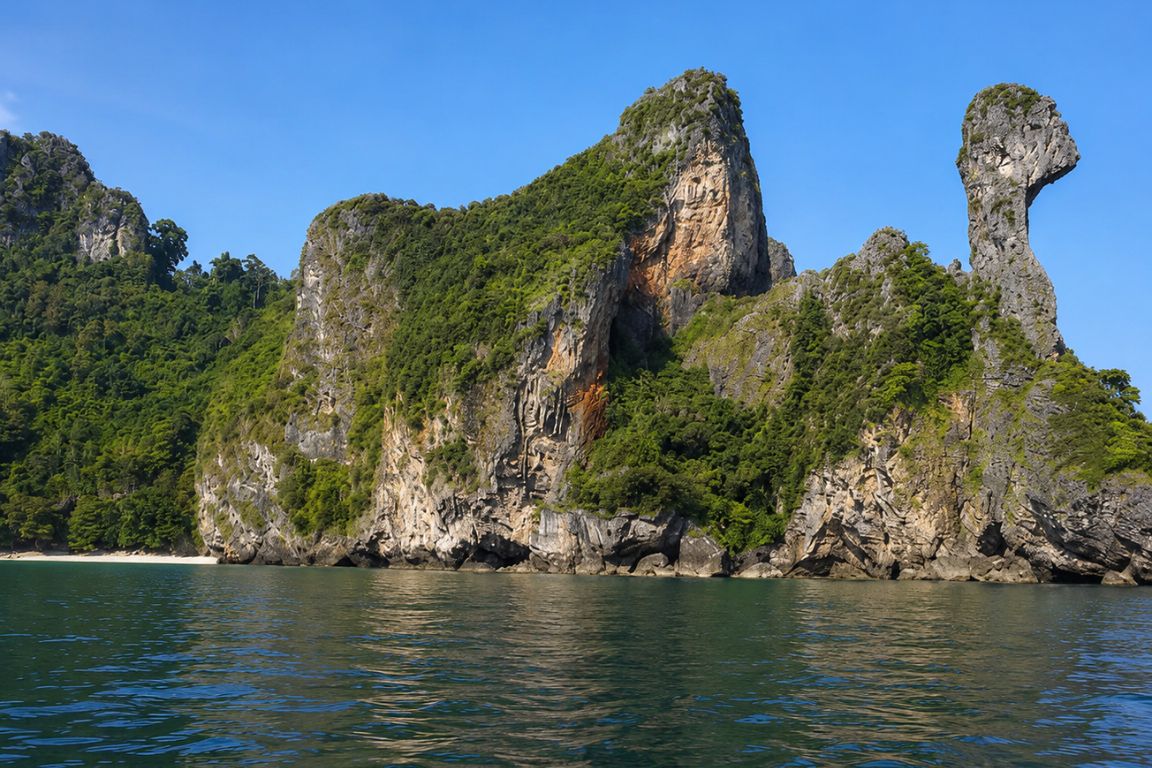
A regular walker in reasonable shape gets up with several rest stops and no drama. A runner who treats it as a challenge often suffers more than a slow, methodical climber, because pace is the enemy in that humidity. Guides describe it as leg-burning, and the people who cope best are the ones who accept from the first flight that this is a stop-start climb.
The descent deserves its own warning. Tall, uneven risers are harder to come down than to go up, especially on tired legs, and there is no handrail on every flight. Anyone with knee trouble should think about the way down before they commit to the way up, because there is no other route off the top.
Water is the other variable people underestimate. There is no shop at the summit, the exposure is total, and the climb takes place in air that sits in the low thirties for most of the year. Carry more than you think you need, and drink before you are thirsty rather than after.
| Starting point | What the climb feels like | Allowance to budget |
|---|---|---|
| Regular walker, comfortable in heat | Steady with rests, hardest in the final third | Allow 45 to 60 min up, 30 down |
| Occasional exerciser | Genuinely tough, several long stops | Allow 60 to 90 min up, 40 down |
| Not used to stairs or heat | Turn-back territory, and that is a fine outcome | Allow 90 min plus, or skip the summit |
| Knee or hip problems | The descent is the problem, not the ascent | Consider the forest-floor complex instead |
| Children over about eight | Usually fine with an adult setting the pace | Allow the slowest person's pace throughout |
| Heart condition or pregnancy | Advised against by operators | Explore the caves and forest below |
Those allowances are planning numbers rather than measured times. Build the slower one into your day and you will never be the person holding a tour group at the base.
What Is Actually at the Top?
A large golden Buddha, a summit shrine, a footprint marker, and a 360-degree panorama over Krabi's limestone massifs, the mangrove coast and the flat green country between them. On a clear dry-season morning you can trace the karsts all the way out toward the coast.
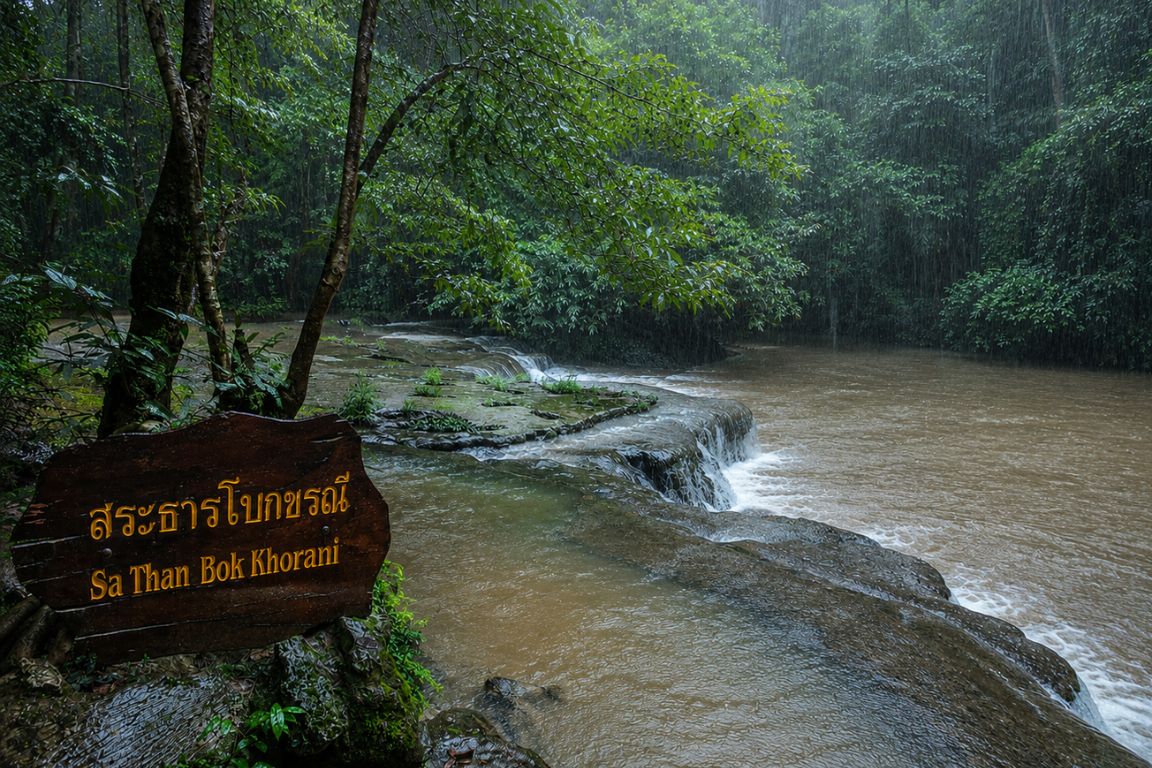
The view is the payment, and it is a genuine one. From the top the karst plain across inland Krabi Province reads as a scattering of vertical islands stranded in farmland, which is exactly what it is: the same drowned-limestone geology as the sea stacks offshore, left standing when the water dropped. Standing there makes the whole coastline make sense in a way no boat trip quite does.
The summit is small and it is a shrine before it is a viewpoint. People pray there. Sweat-soaked climbers taking selfies in front of the Buddha are tolerated rather than welcomed, so keep your shirt on, keep your voice down and step aside for anyone who has come up to worship rather than to photograph.
Weather changes the payoff substantially. Dry-season mornings give the long clear views. Wet-season climbs trade distance for drama: cloud sitting in the karsts, the plain going in and out of visibility, and far fewer people on the stairs. Both are worth doing, for different reasons.
What Is There If You Do Not Climb?
A large forest-floor complex with meditation caves, shrines and a shaded walking loop beneath the outcrop, plus the resident macaques. You can spend an hour at Wat Tham Suea without touching the staircase, and the temple's actual religious life happens down there rather than at the summit.
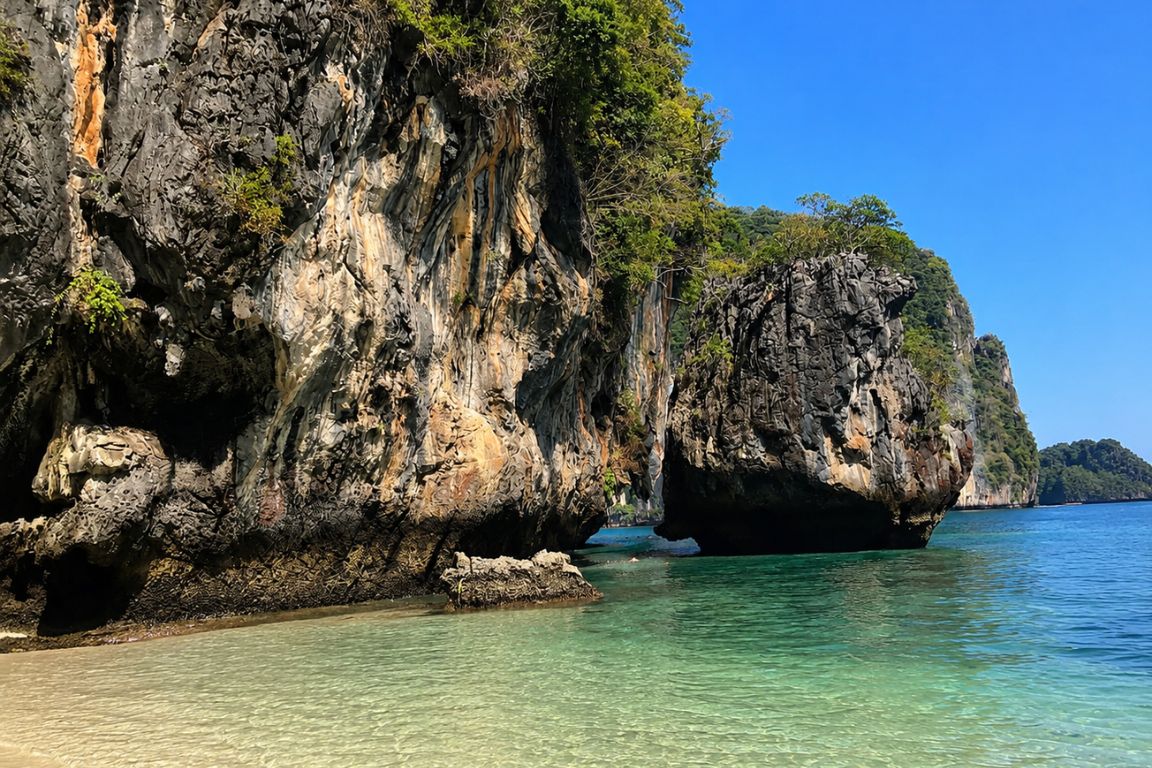
This matters for mixed groups more than anything else on this page. If one person in your party cannot or should not climb, the day does not have to split into a climber and a person sitting in a van. The lower complex is genuinely interesting: caves used for meditation, quiet shrines under the trees, and a cooler temperature than anywhere on the stairs.
The macaques are the one thing to manage down here. They work the base of the staircase and they are practised at snatch-and-grab: sunglasses, water bottles, cameras, anything loose in a hand or a side pocket. Keep bags zipped and do not feed them, which is the behaviour that made them this bold in the first place.
Photography is better below than most people expect. Under the canopy the light is soft, the shrines are quiet and the monkeys are relentlessly photogenic. Anyone travelling with a group where several people are climbing has an hour to fill and no reason to spend it in the car park.
What Should You Wear and Bring?
Shoulders and knees covered, because this is a working temple. Shoes with real grip, not flip-flops. More water than feels necessary, a small pack of tissue for the bathrooms, and nothing loose in your hands where a macaque can reach it.
The clothing rule creates a small conflict with the climb: modest cover is required, and modest cover is hot. The fix is a light long-sleeve layer or a thin scarf carried in a bag and put on at the top, worn with knee-length shorts or trousers. Sleeveless tops and short shorts will get you turned around at the shrine after an hour of climbing, which is a miserable way to learn the rule.
Footwear decides the descent. The steps are smooth-worn concrete and they are slick in any wet weather, which is a real consideration through the monsoon months. Anything with a grip sole is fine. Sandals with no back strap are not.
Bring tissue. National park and temple bathrooms in this part of Thailand generally do not supply it, which is the single most repeated practical tip from travellers who have done the jungle day, and it applies here as much as at the waterfalls.
| Item | Why |
|---|---|
| Shoulders and knees covered | Working temple, enforced at the shrine |
| Grip-soled shoes or trainers | Smooth concrete steps, slick when wet |
| Two litres of water per climber | No shop at the summit, near-total sun exposure |
| Small pack of tissue | Bathrooms rarely supply it |
| Zipped bag, nothing loose in hand | Macaques at the base take what they can reach |
| Light long-sleeve layer | Sun cover on the stairs, modest cover at the top |
| Dry shirt for afterwards | You will be soaked, whatever the month |
What Time of Day Should You Climb?
Early morning, and it is not close. The staircase faces open sky with almost no shade, so the difference between a 7am start and an 11am start is the difference between a hard climb and a genuinely unpleasant one. Late afternoon works too, with the risk of finishing in the dark.
Heat builds through the morning and peaks in the early afternoon, and the exposed upper flights are where that lands hardest. An early start also means quieter landings, which matters because the queueing on a busy staircase costs more time than the climbing does.
Organised jungle tours usually reach the temple in the afternoon, after the hot springs and the Emerald Pool. That order exists because the water stops are better early, and it is a reasonable trade, but it does mean the climb happens at the hottest end of the day. Knowing that in advance changes how you pace the morning: go gently in the pools, save something for the stairs.
If you are making your own way there, treat the temple as a sunrise activity and be walking by seven. You will finish before the tour vans arrive, and the light over the karst plain in the first hour is the best it gets all day.
| Window | Conditions on the stairs | Verdict |
|---|---|---|
| 07:00 to 09:00 | Coolest air, quiet landings, clear morning light | The best window by a wide margin |
| 09:00 to 11:00 | Heat building fast, staircase filling | Workable if you pace it and carry water |
| 11:00 to 14:00 | Peak heat, full exposure, busiest stairs | Hardest window, common on tour schedules |
| 14:00 to 16:00 | Heat easing, crowds thinning | Good, and typical for a jungle day tour |
| After 16:00 | Cool and quiet, light fading fast | Only if you are certain of your pace |
When Is the Best Time of Year to Climb?
Dry season, November through April, gives the clear summit views and firm, dry steps, with the shortest queues in the shoulder months. The monsoon months deliver a quieter climb, cooler air and dramatic cloud views, at the cost of slick concrete underfoot.
January through March is the reliable window for the view: lowest humidity, clearest air, and the karst plain visible right out toward the coast. Those are also the months when Krabi is busiest overall, though the temple absorbs crowds better than any boat pier does. The wider seasonal picture sits in our guide to Krabi in the dry season.
The monsoon case is stronger here than for almost any other Krabi activity. Inland attractions including this temple, the Emerald Pool and the hot springs are genuinely better in the wet months: lush, cooler, far less crowded, with dramatic cloud views from the summit. They are also the standard fallback when a boat day gets cancelled, which our page on Krabi in the rainy season covers in detail.
The one wet-season caution is footing. Smooth concrete plus rain equals a slippery staircase, and high-grip footwear stops being a nice-to-have. Anyone unsure about the descent in those conditions should make the call at the bottom rather than at the top.
| Months | On the stairs | At the summit |
|---|---|---|
| November to December | Drying out, comfortable air | Clear views returning, crowds building late December |
| January to February | Firm and dry, lowest humidity | Best long views of the year |
| March to April | Dry but hot, early start essential | Clear, hazier as the heat builds |
| May to August | Slick after rain, cooler air | Cloud and drama, quiet landings |
| September to October | Wettest, most slippery | Quietest climb of the year, views hit or miss |
How Do You Combine the Temple with the Emerald Pool?
They sit on the same inland circuit, which is why almost every jungle day tour runs the hot springs, the Emerald Pool and Tiger Cave Temple as one nine-hour loop. Water first, temple last. It is the most efficient way to see Krabi's non-coastal side in a single day.
The order is deliberate. The full-day jungle tour we list runs for nine hours and combines hot spring water, the Emerald Pool and Tiger Cave Temple. National park fees and lunch are included, and current pricing is shown for your selected travel date on the listing.
Doing it independently is possible and slower. The three stops are spread across inland Krabi, none are walkable from each other, and you would need a full day with a driver or a scooter plus separate entry fees at each. The tour's value is the routing rather than the guiding, which is a fair reason to take it even if you normally travel independently.
What the pools and the temple do for each other is the real argument. Soaking in thermal water and swimming in a spring-fed pool for a morning is exactly the wrong preparation for a staircase, and exactly the right reward if you climb first. Our guide to the Emerald Pool and the hot springs covers that half of the day in full, including which pool closes in the wet months.
One logistical note if you are staying on the peninsula: Railay pickup is not included on the jungle day, so you would take a boat to Ao Nam Mao Pier yourself and meet the van, with the meeting details confirmed directly for your booking. Pickup coverage outside the stated Railay exclusion is not specified in the listing. Related reading: Ao Nang
Listed circuit Nine hours total Hot spring water, Emerald Pool and Tiger Cave Temple Thai lunch, park fees, English guide and air-conditioned vehicle included
How Do You Get to Tiger Cave Temple?
Every route is a road route. The temple sits inland beyond Krabi Town, well away from the beaches, so you are choosing between a tour with pickup included, a private car or taxi, or a rented scooter. There is no boat, and it is not walkable from any beach base.
The tour option is the simplest because the temple rarely justifies a dedicated half day on its own. Folding it into the inland loop with the pools gives the drive somewhere else to go, while pickup coverage must be checked for your accommodation; Railay hotel transfer is excluded.
If you want a sunrise climb, arrange transport separately because the listed group circuit does not publish its temple arrival time. Arrange the return leg before you are dropped off, because this is not a place where transport waits around for tourists, and the walk out is not a walk.
Scooters are the cheap option and the one that carries real risk. Thai road conditions, unfamiliar traffic and a long inland ride add up, and a rental without proper insurance is a bad trade for saving a few hundred baht. If you are already on two wheels and comfortable with it, the ride is straightforward.
Who Should Skip the Summit?
Pregnant travellers and anyone with a heart condition are advised against the climb by the operators who run it. Add anyone with unmanaged knee or hip problems, because the descent is worse than the ascent, and anyone who struggles in humid heat. The forest complex below is a genuine alternative, not a consolation.
Turning back partway up is a normal outcome and nobody at the temple thinks anything of it. The staircase has landings for exactly that reason. Deciding at flight four hundred that today is not the day is a better story than being helped down from flight nine hundred, and the view improves gradually enough that a partial climb still pays.
For travellers weighing what fits their mobility across a whole Krabi trip, the same logic that shapes our advice on boat tours for seniors applies here: pick the version of the activity you will enjoy rather than the version that sounds most impressive.
If the temple is off the list entirely, the inland day still works. A separate option is the 3.5-hour Klong Root kayaking and swimming outing, which excludes pregnant travelers and people with mobility impairments, and it slots neatly into a plan built around island-hopping day trips from Krabi on the other days. Our roundup of things to do in Krabi sets out the full inland list.
| Traveller | Verdict |
|---|---|
| Reasonably fit, early start | Climb it, best single view in Krabi |
| Reasonably fit, midday arrival | Climb slowly, double your water |
| Knee or hip problems | Skip the summit, the descent is the risk |
| Heart condition or pregnancy | Advised against by operators, stay below |
| Families with young children | Forest complex below, summit for older kids |
| Wet-season visitors | Go, but only in grip-soled shoes |
| Anyone with one inland day | Take the jungle loop, temple included |
Frequently Asked Questions
How many steps are there at Tiger Cave Temple?
The figure quoted by tour operators and guides is 1,260 steps to the summit shrine. They are uneven, and the steepest flights come near the top where there is no shade at all. Counts repeated elsewhere vary slightly with where a person starts counting, so treat 1,260 as the working number rather than a survey.
How long does the climb take?
As a planning allowance, budget 45 to 60 minutes up for a regular walker and 30 minutes down, and 90 minutes or more up if you are not used to stairs or humidity. Pace matters more than fitness. The people who cope best are the ones who plan to stop several times from the first flight.
What is the dress code at Tiger Cave Temple?
Shoulders and knees covered, as at any working Thai temple, and it is enforced at the summit shrine. The practical solution is knee-length shorts or trousers plus a light long-sleeve layer you carry up and put on at the top, which also gives you sun cover on the exposed upper flights.
Can you visit without climbing the steps?
Yes, and plenty of people do. The forest-floor complex below the outcrop has meditation caves, shrines and a shaded walking loop, and it is where the temple's religious life actually happens. It fills an hour comfortably, which makes it a real option for mixed groups rather than a waiting area.
Are the monkeys a problem?
They are opportunists rather than a danger. Macaques work the base of the staircase and are practised at taking sunglasses, water bottles and anything loose in a hand or an open pocket. Keep bags zipped, carry nothing in your hands, and do not feed them, which is what made them this confident.
Is Tiger Cave Temple worth it in the rainy season?
Yes, and arguably more so. Inland Krabi is greener, cooler and much quieter in the wet months, and cloud sitting in the karsts makes the summit view dramatic rather than distant. The catch is footing: the concrete steps get slick, so grip-soled shoes stop being optional.
Check your travel date before arranging the rest of your Krabi plans
Match the outing to your plans
Blank fields keep the initial suggestion. Age pricing alone does not confirm suitability; if eligibility is unverified, the tool will not recommend a match. Check pickup and restrictions for your selected package.
Compare two total quotes
Use current quotes in the same currency, including park fees, transfers and option extras.
Initial recommendation. Adjust the optional choices to match your plans.
All day Krabi Jungle Tour (Hot Spring Water, Emerald Pool, Tiger Cave Temple)
Place the temple inside a small-group inland day with Emerald Pool, hot spring water, lunch, park fees, a guide and vehicle transport.
9h · English guide listed · Jungle day trip with lunch and listed entrance fees; temple steps are strenuous. Railay hotel pickup is not included. · Confirm your selected option’s pickup, inclusions, fees and participant restrictions before booking.
Choose a date to view the published schedule. Confirm availability and final price on Viator.
No reviewed option matches these choices.